Inside a Bhaktapur carving workshop
What Newar woodcarvers make, the wood and tools they use, how the craft is learned, where to see it in Bhaktapur, and what a morning at the bench is like.
Walk through Bhaktapur's old town and look up. Almost every old building has carved wood somewhere: window frames with peacocks or lotus petals, roof struts carved as gods, door frames topped by a semicircular torana. This is Newar woodcarving, and in Bhaktapur it's still a working craft, taught in small family workshops a few minutes from the main squares.
Where to see the carving
- The Peacock Window, in Tachupal Tole: a lattice window on a former priests' house, with a peacock at its centre. It's Bhaktapur's best-known piece of woodwork.
- The 55-Window Palace, in Durbar Square: a long row of carved windows along the old royal palace.
- Taumadhi Square: look at the roof struts of the Nyatapola and Bhairabnath temples, each carved as a deity.
- Tachupal Tole: the oldest part of the city, around the Dattatreya temple, with several restored priests' houses.
A short history
Woodcarving in the Kathmandu Valley goes back well over a thousand years, but most of what you see today dates from the Malla period. From the late 15th century until 1768, Kathmandu, Patan and Bhaktapur were rival kingdoms, and their kings spent heavily on temples and palaces. Carvers worked to a shared set of forms: struts showing many-armed deities, windows built up from lattices and frames, and door surrounds with mythical creatures.
Many pieces have been repaired or replaced over the centuries. After the 2015 earthquake, local carvers made new struts and window parts to the old patterns, and some of the work you see is only a few years old.
Motifs to look for
- Lotus: a symbol of purity, and the usual first motif for learners.
- Peacock: common in window lattices, and linked in Hindu tradition with the god Kumara.
- Makara: a water creature with a trunk-like snout, often carved at the ends of door and window frames.
- Deities on struts: many-armed gods and goddesses holding the eaves, sometimes with small erotic scenes carved below them.
Wood and tools
Structural temple work is traditionally done in sal, a dense, durable hardwood that resists insects. It's hard to carve, which is part of the reason old pieces have lasted so long. Workshops may use other woods for smaller decorative pieces and for teaching.
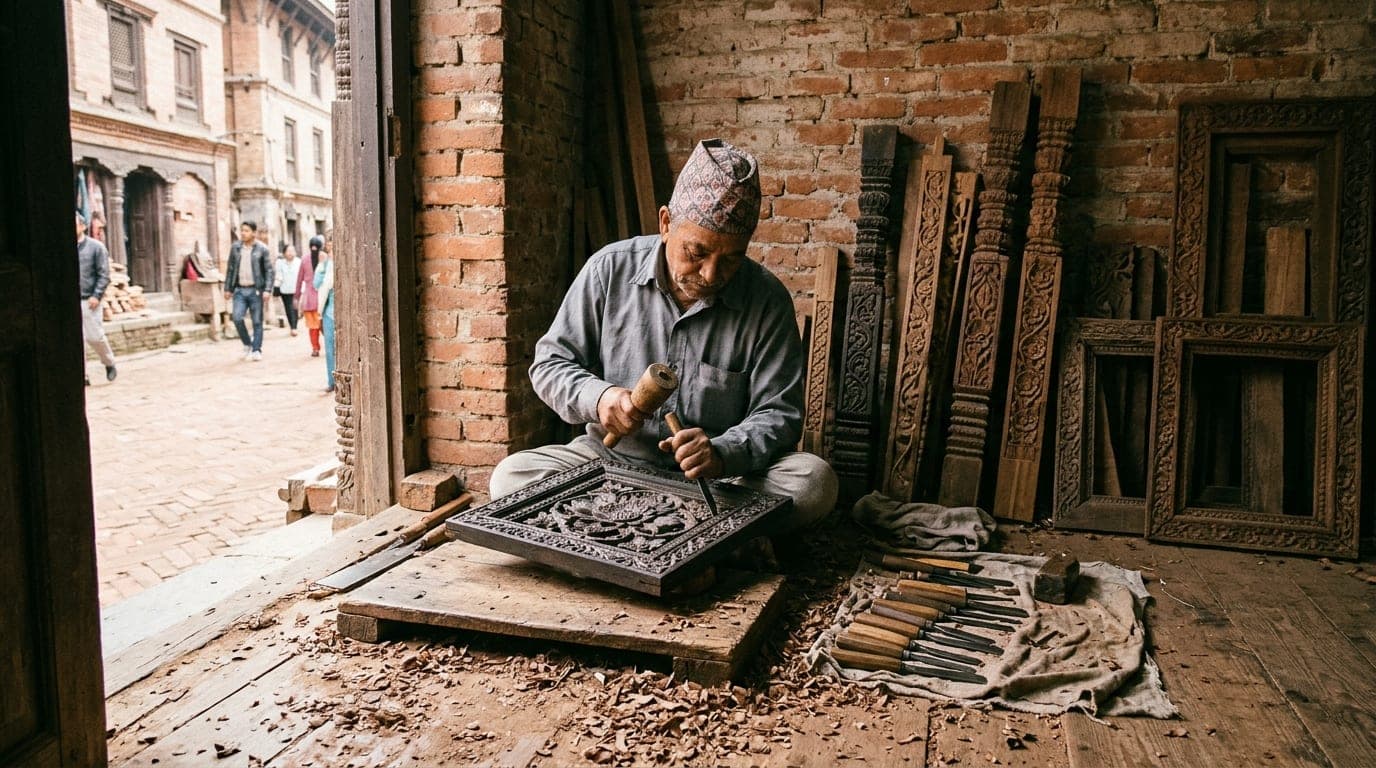
The tools are simple: chisels in different widths and profiles (flat, curved and V-shaped) and a wooden mallet. Carvers often sit low, holding the work steady with their feet or a simple clamp, and sharpen their tools many times a day.
How the craft is learned
Traditionally, carving was a family trade, and children learned by watching and helping for years before they were trusted with a visible surface. Apprentices copy their teachers' motifs until the forms are second nature. Today the craft competes with better-paid work in tourism and abroad, and workshops that teach, sell directly and take commissions are one of the ways it keeps going.
A morning at the bench
If you try carving yourself, the first hour is mostly about safety and control: how to hold the chisel so it can't slip towards your hand, how the mallet drives the cut, and how to read the grain so the wood doesn't split. Then you transfer a design, usually a lotus or a simple flower border, onto a small panel and start cutting away the background.
Progress is slow. Most beginners are surprised how much time goes into one petal, and how much difference a sharp chisel makes. Over a few mornings the motif starts to stand up from the background, and the last session is spent cleaning edges and oiling the wood. What you end up with won't be perfect, but you'll look at every carved window differently afterwards.
Buying carvings
Bhaktapur has many shops selling carved windows, masks and panels. A few things to check before you buy:
- Ask where and by whom a piece was made, and whether you can see the workshop.
- Look at the back and the edges: hand carving shows small irregularities that machine work doesn't.
- Old pieces may need export permission from Nepal's Department of Archaeology. New work is fine, but keep the receipt.
- Some countries, such as Australia and New Zealand, inspect wooden items at the border, so declare them.
Try it with us
Our wood carving workshop in Bhaktapur is five days long: a guided walk past the carved windows, then four mornings at the bench with a master carver, with at most six people per teacher. If you only have half a day, a carving taster can be added to our Kathmandu Valley heritage tour.
Journeys to read about, then live

Everest Base Camp Trek